

Sacred directionality: a primer
Part I: the ordered world and the cosmic schema

This, the first of two essays, is a primer for my C.G. Jung public lecture, in Bristol on Saturday June 13th, on the topic of ‘Initiatory landscapes: maps of personal transmutation.’ See these links for in-person tickets and online tickets.
For much of human history, direction was never just a matter of navigation. The best proof of this is the fact that the first magnetic compasses were used for geomancy. It’s an excellent expression of how the cardinal points have, until the modern era, not been understood solely as abstract coordinates imposed upon a neutral landscape, but as living thresholds that structured cosmology, ritual, kingship, architecture, myth and the relationship between the living and the dead. The ancestral mind inhabited a world in which orientation mattered profoundly. To face east rather than west, to build upon one axis rather than another, or to establish a settlement according to celestial principles rather than practical convenience, was to participate in the ordering of the cosmos itself.
Yet despite the modern tendency to regard north, south, east and west as objective categories, for most traditional societies they were qualitative rather than quantitative. Every direction possessed character. Each was associated with deities, spirits, winds, colours, seasons, celestial events, forms of power and modes of being. Directionality was therefore inseparable from sacred geography and, if anything, gave rise to it.
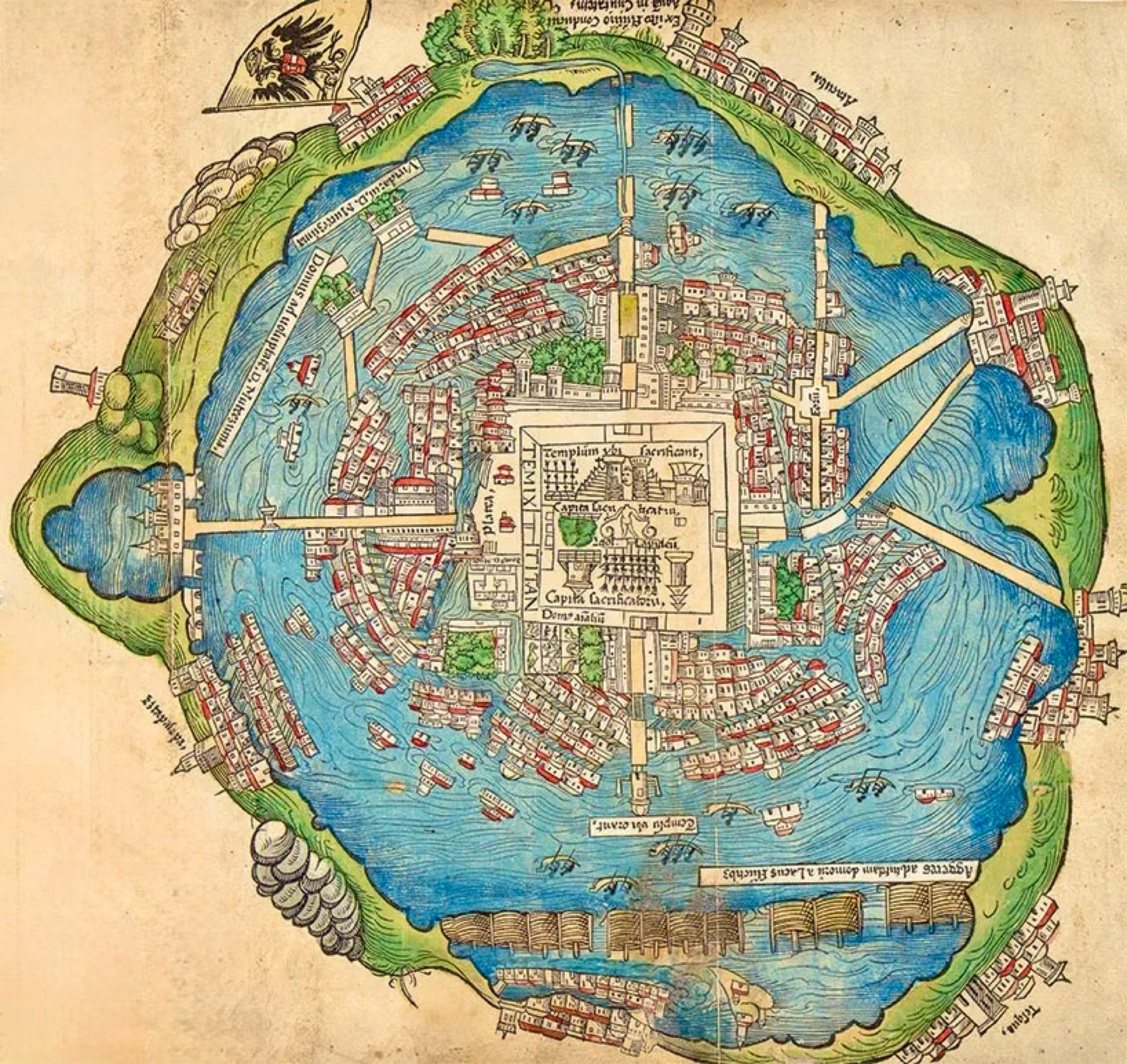
Across the ancient world a remarkably persistent and consistent symbolic grammar emerges. The cosmos is conceived as a structured whole. The earth occupies a middle realm situated between upper and lower worlds. A sacred centre links all three levels. Around that centre are organised the cardinal and intercardinal directions. Settlements, temples, roads, monuments and ritual landscapes reproduce this celestial order upon the earth. The result is a cosmogram: a symbolic, terrestrial map of the universe, and one that endures across all manner of indigenous and ancient cultures.
The four quarters of the world
The most widespread expression of sacred directionality is the quadripartite scheme. In its simplest form the world is divided into four quarters by two intersecting axes. These are often cardinal - north-south and east-west - but not invariably so. Some traditions orient themselves to the intercardinal directions, which correspond with solstitial sunrise and sunset positions. But the underlying principle remains unchanged: the cosmos is divided into ordered regions whose relationships define the structure of existence.
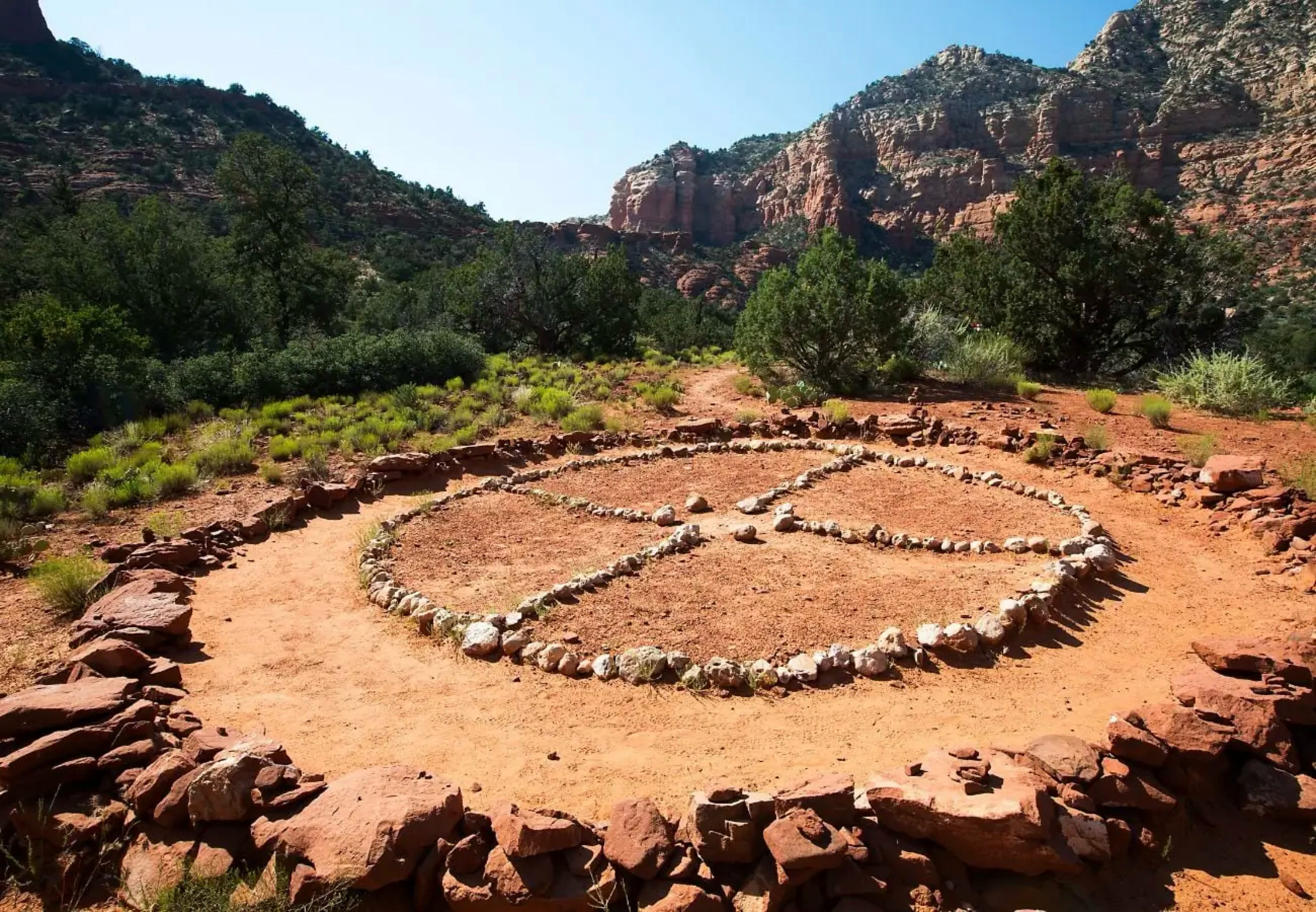
Such fourfold cosmologies appear throughout Eurasia and the Americas. The Hopi ceremonial landscape, for example, is organised around a quadripartite cosmology oriented to the rising and setting positions of the midsummer and midwinter sun. Chinese cosmology assigns the four directions to four celestial beasts. Hindu traditions place the Lokapalas - the directional guardians - at the four quarters of the universe. Norse mythology situates four dwarves at the edges of the world supporting the sky. Egyptian religion distributed the Four Sons of Horus among the cardinal points. Later ceremonial magic populated the same structure with archangels, elemental rulers and watchtowers. These correspondences are not arbitrary. They express a fundamental conviction that cosmic order manifests through spatial order.
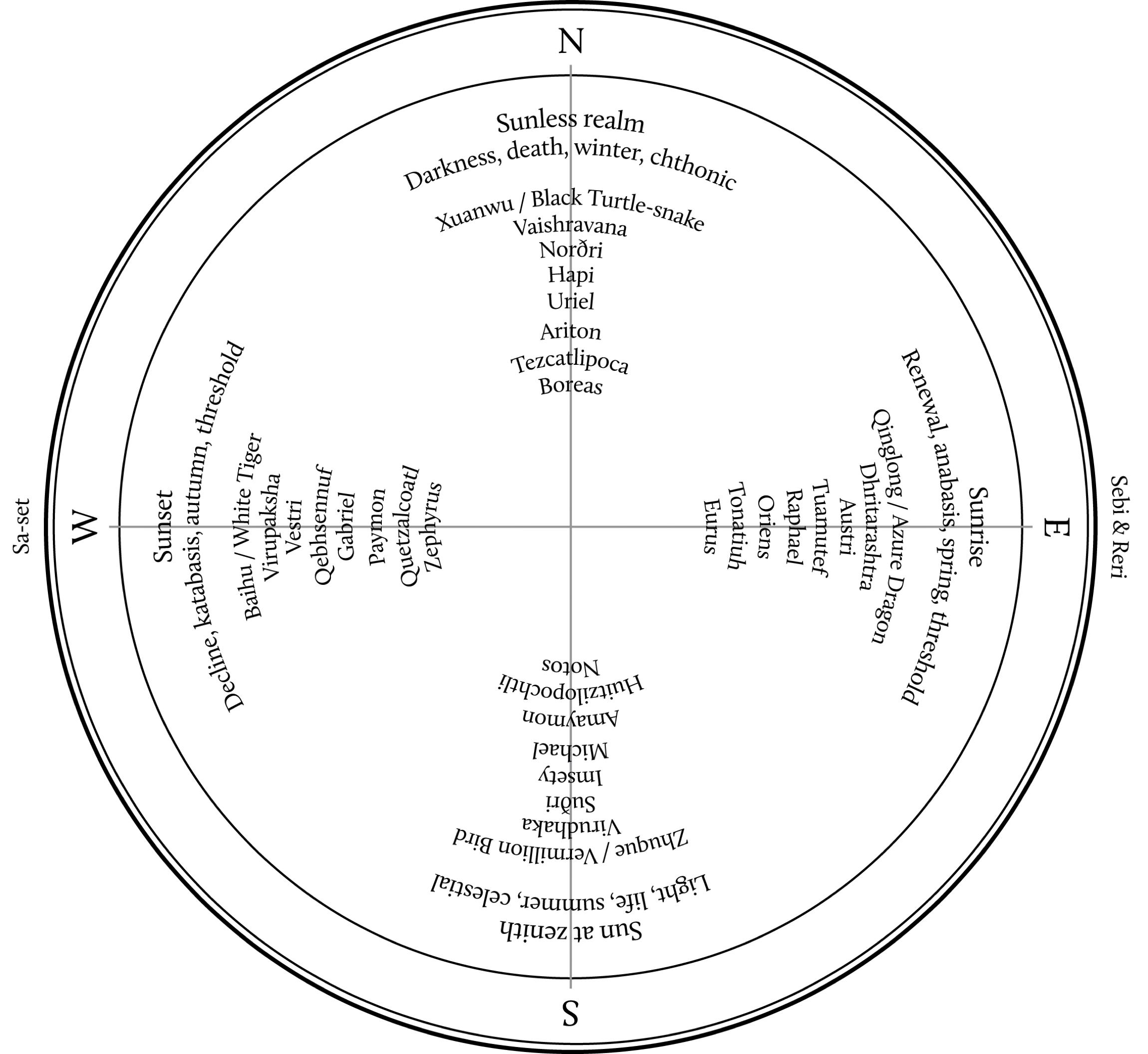
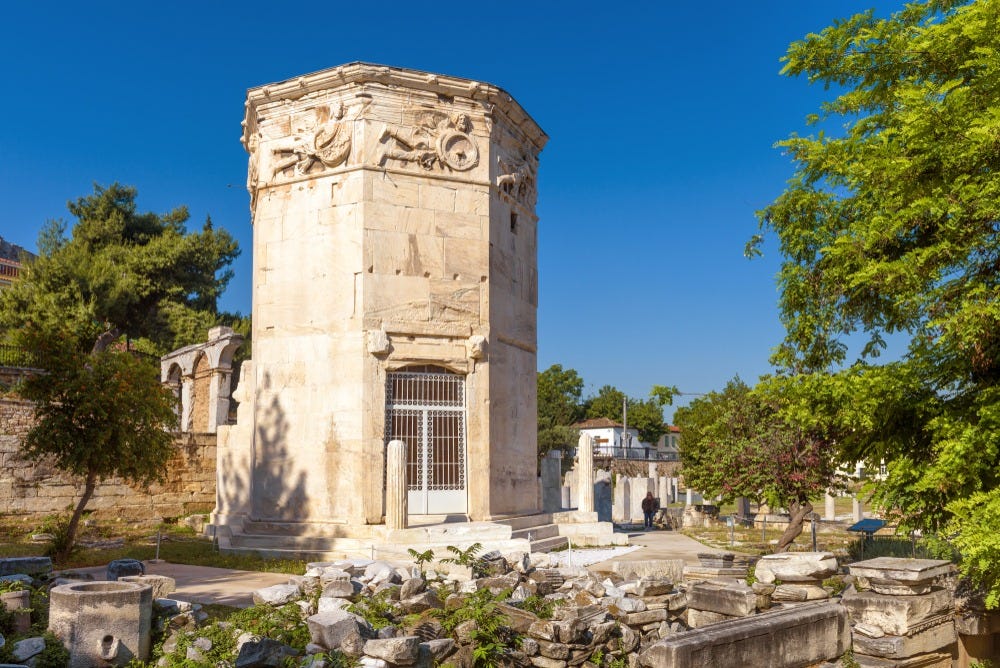
The fourfold model frequently expands into an eightfold scheme incorporating the intercardinal directions. Here the compass becomes a wheel. The world is no longer divided merely into quarters but into octants, each possessing distinctive powers and associations. The Roman Tower of the Winds in Athens illustrates this development. Its eight-sided form assigns a divine wind to each compass point: Boreas, Kaikias, Apeliotes, Eurus, Notus, Livas, Zephytus and Skiron. Every direction possesses a meteorological personality conveyed upon the breath of its presiding deity. Direction is therefore animated, intentional and alive.
The sacred centre
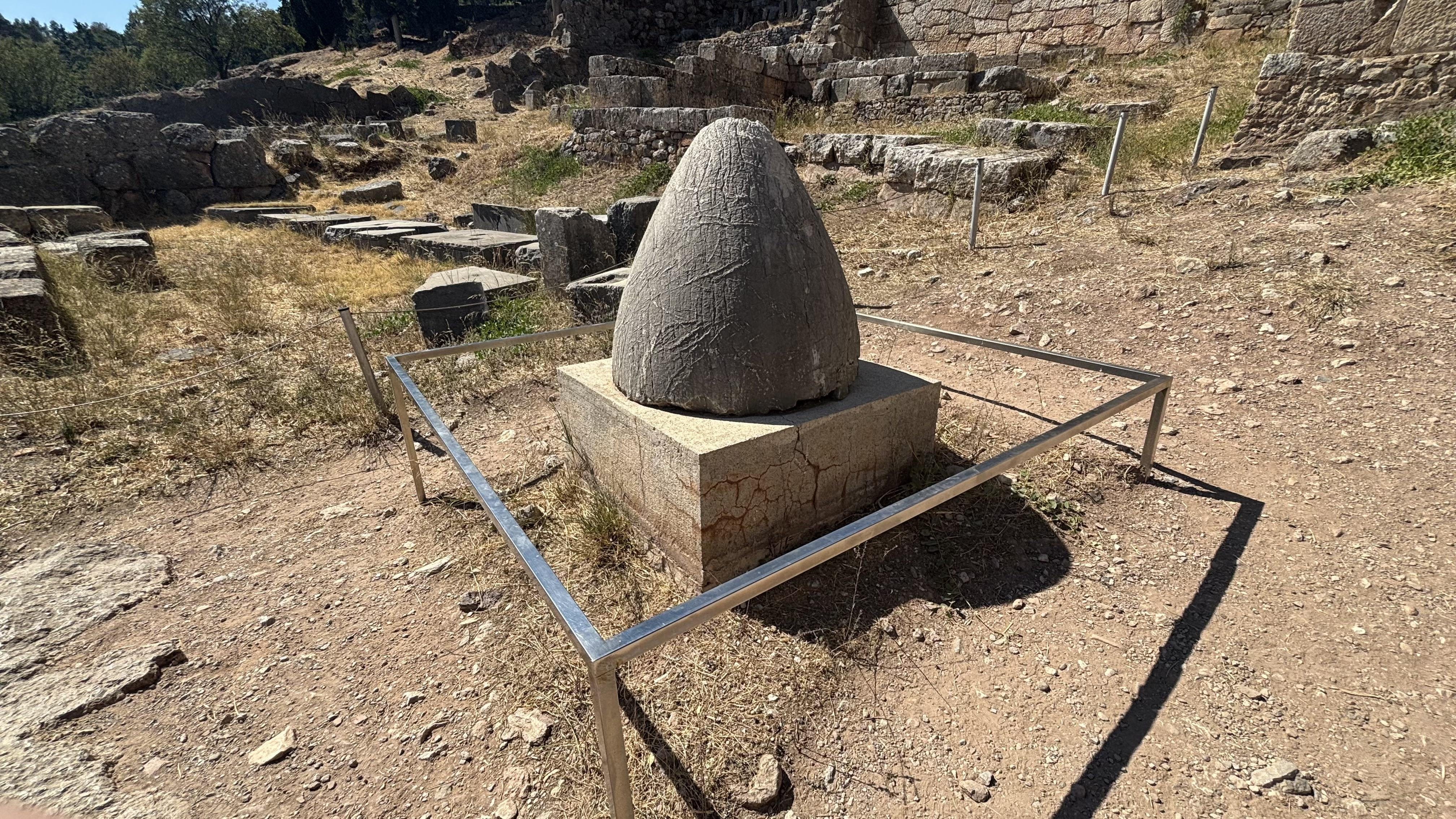
If the four directions constitute the structure of the world, the centre is its heart. Almost every cosmological system contains an axis mundi- a central point connecting heaven, earth and underworld; simultaneously a geographical location and a metaphysical principle. This centre may be represented by a mountain, a tree, a spring, a hill, a temple, a palace, a city, a cave or a pillar.
Mount Meru, Yggdrasil, Olympus, the omphalos at Delphi, the ziggurats of Mesopotamia, the sacred mountain of the Hopi, the world tree of Siberian shamanism and the holy mountains of Mesoamerica all fulfil the same role.
From it emerge rivers, roads, lineages and divine authority. It is the point through which communication between realms becomes possible. In many traditions it serves as a portal through which gods descend, spirits ascend and shamans travel.
When sacred landscapes are mapped, they frequently reveal a centred geometry. Four rivers flow from a central source. Four roads radiate from a central sanctuary. Four tribal territories surround a ritual nucleus. Such arrangements are not practical necessities but expressions of cosmological belief and symbolic thinking. They represent an ordered world as microcosm of an ordered cosmic, oriented around a sacred centre.
The three-tiered cosmos
Underlying these arrangements is an even more fundamental conception: the three-tiered cosmos. This model divides reality into an upper world, a middle world and a lower world. The upper realm is the domain of celestial powers, stars, gods and immortality. The middle world is the realm of humanity, animals and ordinary existence. The lower world contains ancestors, spirits of the dead, chthonic powers and sources of hidden wisdom. Although details vary dramatically between cultures, the basic structure remains consistent.
Shamans ascend to the heavens or descend into underworlds. Mythic heroes undertake katabasis - descent into the realm of death - and anabasis - return to the world above. Sacred mountains unite heaven and earth. Caves connect earth and underworld. Trees and pillars bind all three realms together. Directionality acquires much of its importance because it mediates between these levels.
In this schema the horizon is not simply a line but a threshold. Sunrise and sunset become acts of passage between worlds. Solstices and equinoxes become moments when cosmic boundaries are altered. Sacred centres become points of communication among the three realms. To orient oneself correctly is therefore to orient oneself within the structure of existence itself.
Solstices and equinoxes
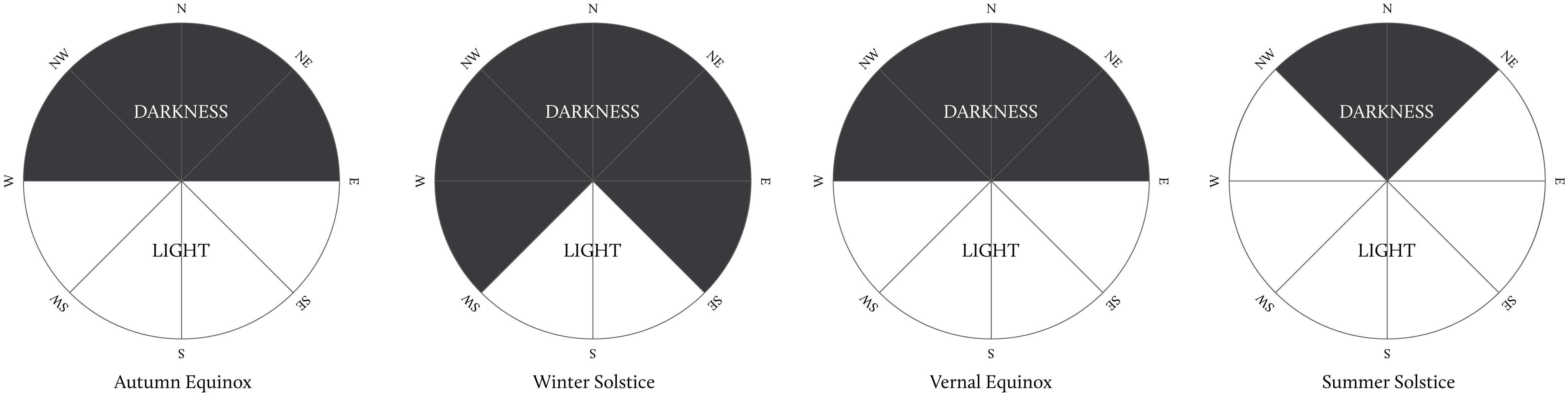
The annual solar cycle provided one of the primary frameworks through which sacred directionality was understood. The equinoxes divide the year into balanced halves. Day and night achieve parity. The solstices mark extremes. At midsummer the sun reaches its furthest northern rising and setting positions. At midwinter it reaches its furthest southern limits. These celestial turning points are among the most conspicuous and predictable events in nature, and the ancestral mind tracked them obsessively.
Millennia before written calendars, the horizon itself functioned as a cosmic clock. By observing where the sun rose and set, communities could determine seasons, organise agriculture and regulate ceremonial life. Yet the importance of the solstices extended beyond practicality. The moments when the sun appeared to stand still carried immense symbolic weight. They represented pauses in cosmic motion. The year itself seemed suspended; liminality intensified, boundaries weakened, and communication between worlds became possible.
Many traditional societies regarded solstitial periods as times when spirits moved freely between realms via celestial gates, marked by the crossing of the Milky Way and the ecliptic. These were the occasions when ritual efficacy reached its peak. The solstice therefore became both an astronomical event and a metaphysical threshold.
Monumental alignment
The archaeological record repeatedly demonstrates humanity’s determination to embed celestial order into the landscape. Throughout Europe, the Near East, Asia and the Americas, monuments were oriented toward significant celestial events. Stonehenge famously aligns with midsummer sunrise and midwinter sunset. Newgrange admits the rays of the winter solstice sunrise into its innermost chamber. Maeshowe is illuminated by the midwinter setting sun. Egyptian temples frequently align with solar events. Chaco Canyon contains monumental architecture oriented toward celestial cycles. Numerous medicine wheels in North America encode sophisticated astronomical observations.
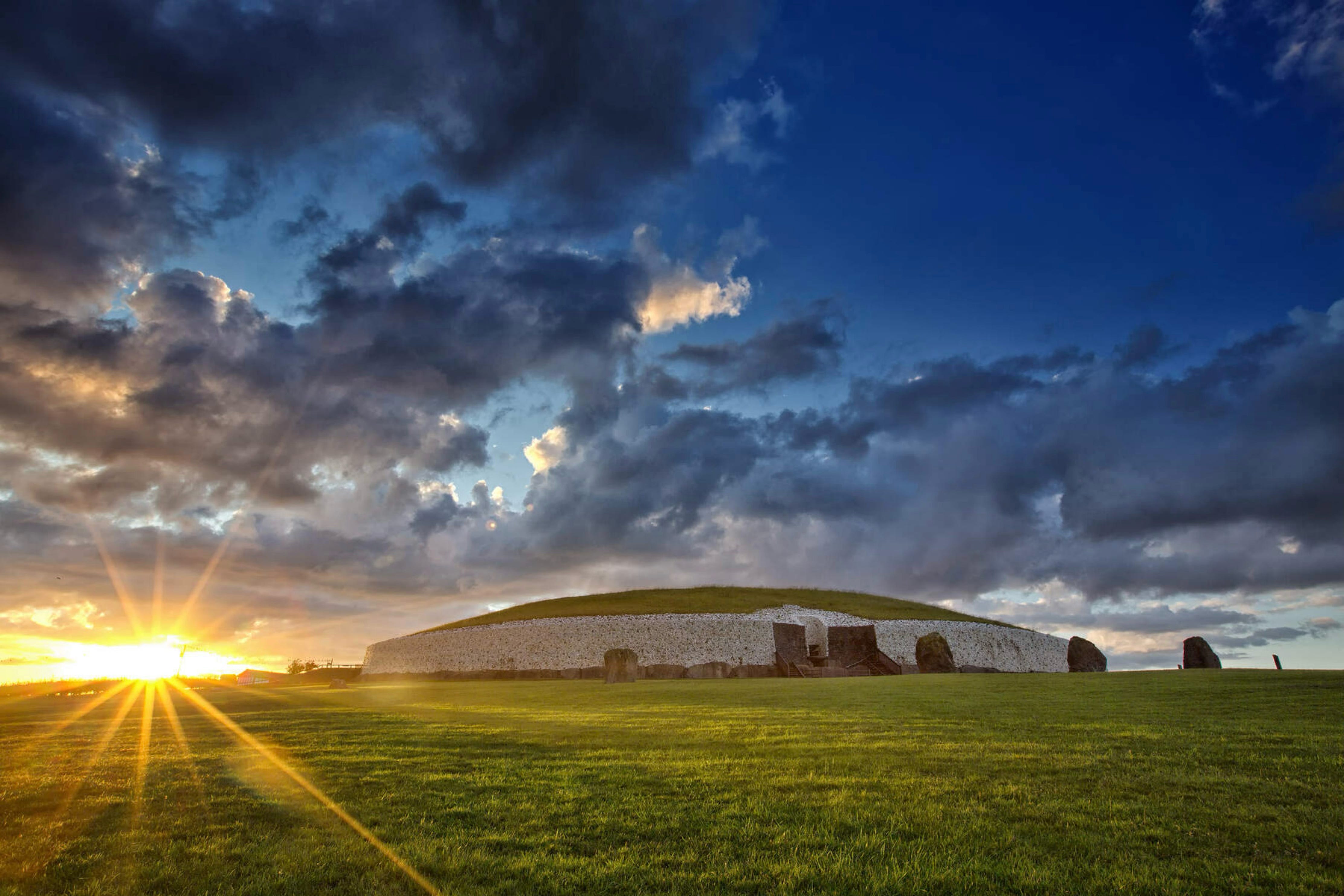
Monumental orientation expresses a desire to synchronise terrestrial space with celestial order, but not in purely calendrical terms. The monument becomes a bridge between realms and architecture transforms into cosmology rendered in stone. The landscape below is brought into correspondence with the heavens above in a way that is fundamentally sympathetic. By reproducing cosmic order on earth, communities sought to participate in the apparent harmony of the universe.
The Etruscan cosmogram
Few cultures demonstrate the relationship between directionality and cosmology more clearly than the Etruscans. Their influence upon Roman religion and urban planning was profound, yet their underlying cosmological assumptions remain insufficiently appreciated. They conceived the heavens as a circle divided by two intersecting axes into four principal regions. These quadrants were further subdivided into sixteen houses occupied by different divine powers. This celestial arrangement provided the template for terrestrial organisation.
The establishment of a settlement was not primarily an engineering exercise but a sacred act. Specialist augurs identified favourable locations by observing birds, weather phenomena, lightning and celestial movements. Their procedures were codified in ritual texts known as the Rituales. Once a site had been selected, two primary axes were established. The north-south axis became the cardo or cardine. The east-west axis became the decumanus. At their intersection lay the mundus, which functioned as an omphalos - a sacred centre and portal linking the human realm with the underworld. The mundus represented the point at which the three-tiered cosmos intersected.
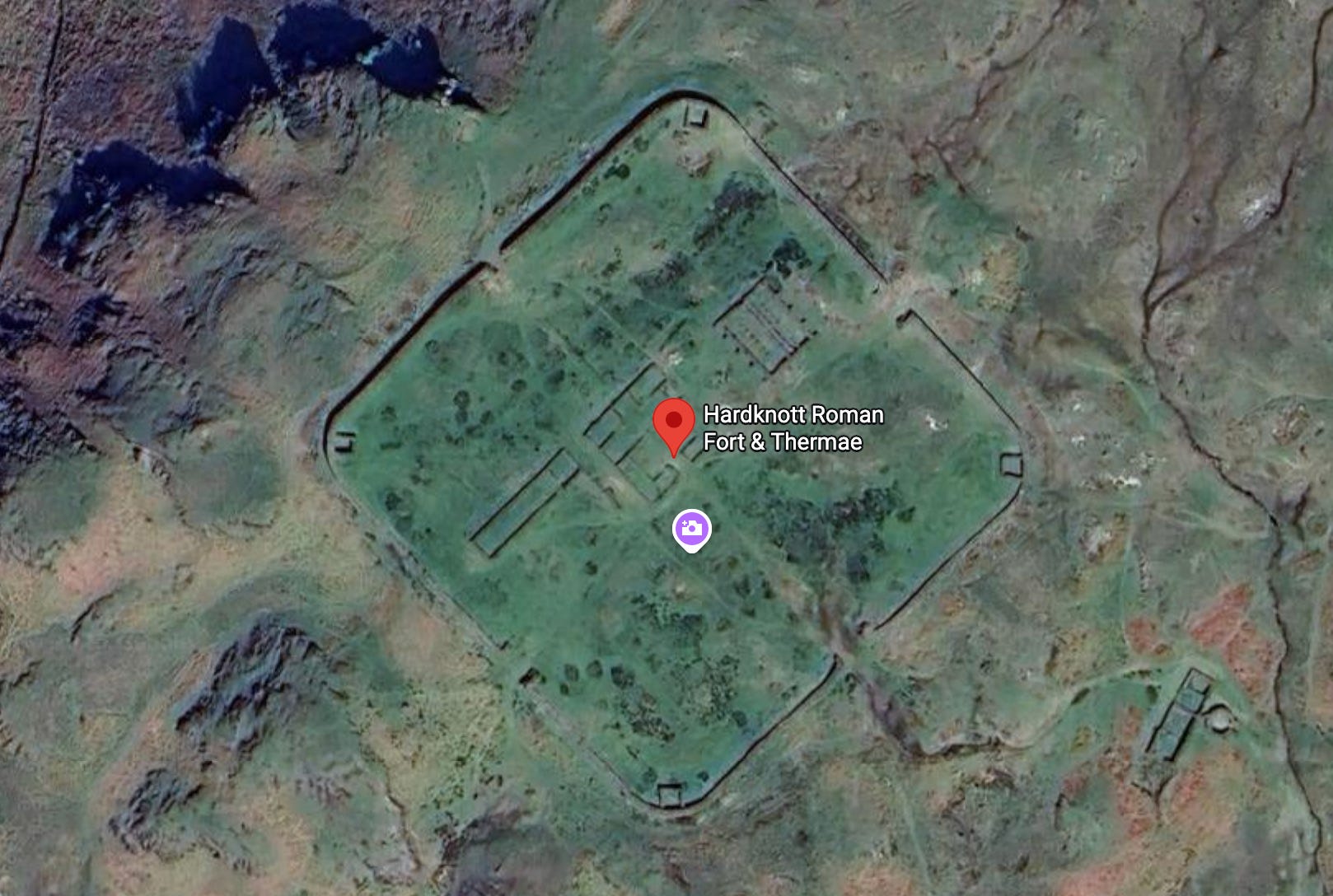
Roman town planning later adopted this scheme almost wholesale, particularly in relation to the organisation of legionary fortresses. The Roman castrum at Hardknott Pass in Cumbria is oriented to the solstices. And at York the via praetoria of the original Roman orthogonal layout is preserved in the street known as Stonegate - which is oriented to the winter solstice sunset. Studies have revealed that the orientation of Roman towns in Italy is not random but rather comprises two types, one of which is characterised by its orientation to the winter solstice sunrise. The characteristic Roman city, with its orthogonal streets and four gates, is therefore not simply a practical design but a cosmological diagram.
Solstitial cosmology: quartering the auspices
The Etruscan directional system was deeply informed by the solar cycle. East, where the sun emerged from the underworld, was generally auspicious. The northeast, corresponding to the summer solstice sunrise, represented supreme good fortune and housed the most benevolent divine powers. The southeast, associated with the winter solstice sunrise, was linked with fertility, water and natural abundance. The western quadrants possessed more ominous qualities. The northwest, associated with the summer solstice sunset, belonged to fearful and fateful powers. The southwest, associated with the winter solstice sunset, was linked to infernal and chthonic deities. Divination occurred as a result of augurs observing the movement of birds, the distribution of the seats of the gods, the weather - especially lightning - and celestial bodies in relation to the quadrants they occupied. In this way, the location and movement of all sky-borne and earth-bound things within and across the four solstitial thresholds informed the process of prognostication, and the diurnal and annual death of the sun upon the horizon therefore acquired profound religious significance.
Recent studies of Etruscan temples reveal a notable preference for orientations associated with the winter solstice arc and the southwestern horizon, suggesting a cosmology preoccupied not merely with solar power but with solar death, descent and renewal. This concern becomes especially visible in relation to the mundus and its underworld associations. The sacred centre was not only a place of celestial communication but also a gateway to infernal realms. The Etruscan city therefore embodied a complete cosmological system. It was simultaneously map, temple and machine for mediating between worlds.
Sacred landscapes: the pattern encoded
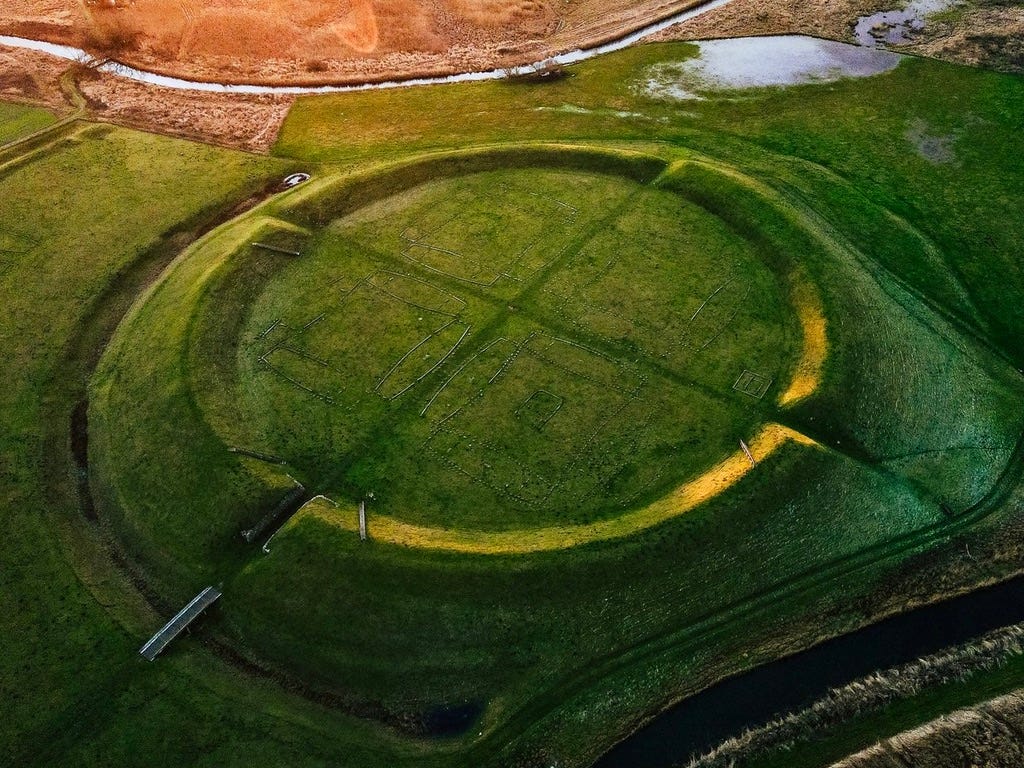
The same principles appear repeatedly elsewhere. Viking ring fortresses such as Trelleborg employ orthogonal axes dividing circular enclosures into four quarters. Traditional Norwegian farmsteads encoded directional symbolism into domestic space itself. North became associated with spirits and death. South represented life. East and west acquired gendered associations. Ritual activities were organised according to directional correspondences. Iron Age roundhouses in Britain appear to have been similarly structured. Entrances often faced significant solar positions, while interior spaces were divided according to symbolic functions.
Across the world, sacred landscapes repeatedly reveal the same organising logic: a centre, four directions, an upper world, a lower world, and correspondences between celestial order and terrestrial arrangement. The details vary, but the grammar remains remarkably constant. To know where one stands - ‘here’ - is to know where one exists within the structure of reality, and to acknowledge oneself as a microcosm; in recognising this, we become our own axis mundi and the centre of our own cosmos.